
01 / Make the decision
Train
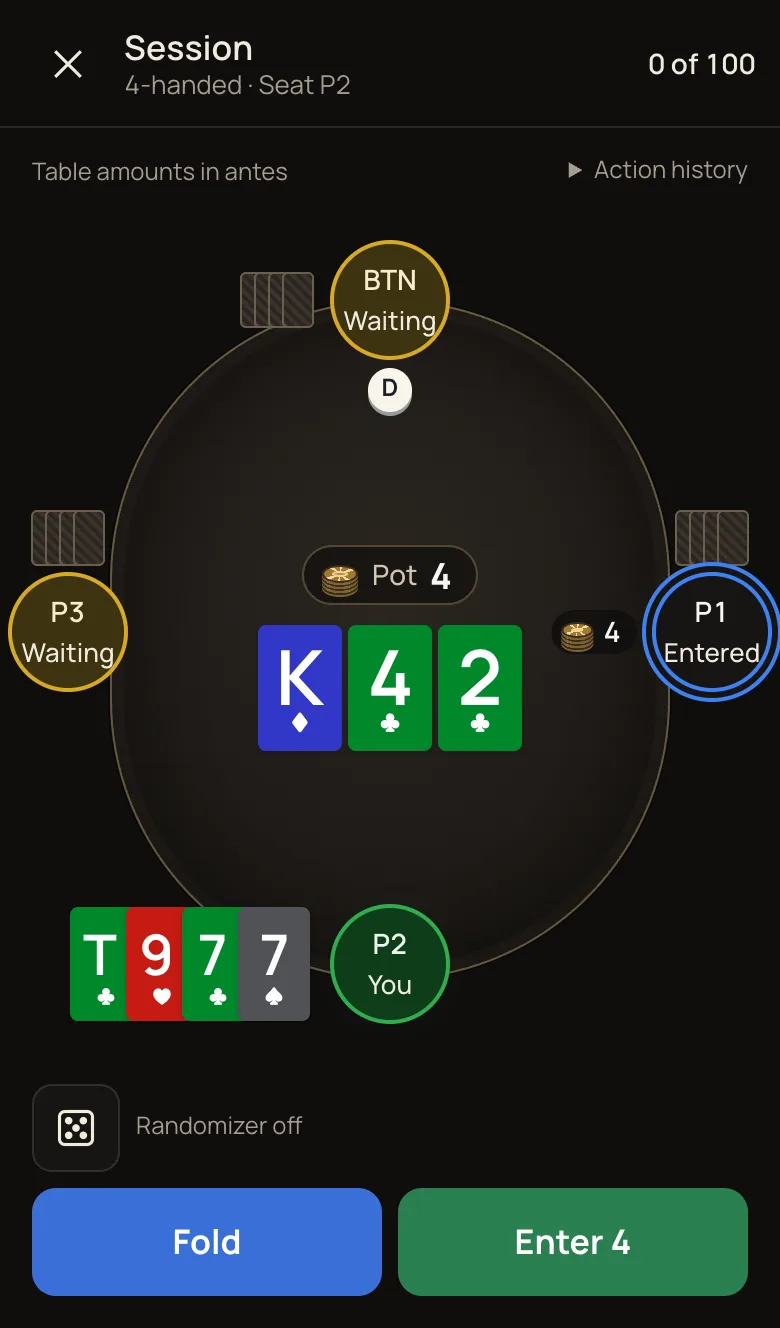
Real spots from the strategy library. Decide, then see the EV of both actions.
PLO bomb pots. One decision on the flop.
Everyone antes. On the flop, enter for a fixed wager equal to the initial ante pot, or fold. Practice this one-decision PLO bomb pot game and see what your choices were worth.
Built on a reviewed strategy library, with the evidence and limits in the open. Explore the methodology.
That was the five-hand demo. The full trainer deals new spots; you can replay this demo any time. 20 free hands a day at one table size you choose, no credit card.
Create a free account Go to appA real decision. A recorded answer. Five three- and four-player spots from the strategy library. This demo replays saved evaluations, not a live solve.
One hand at a time
Read the flop, your cards and the action before you. Enter or fold.
Compare both actions in antes. See the reasoning behind the verdict.
Revisit the same decision while the explanation is fresh.
Four ways to work
Drill single spots, play full orbits, read the stored strategy, and see which spots cost you the most antes.
Real spots from the strategy library. Decide, then see the EV of both actions.
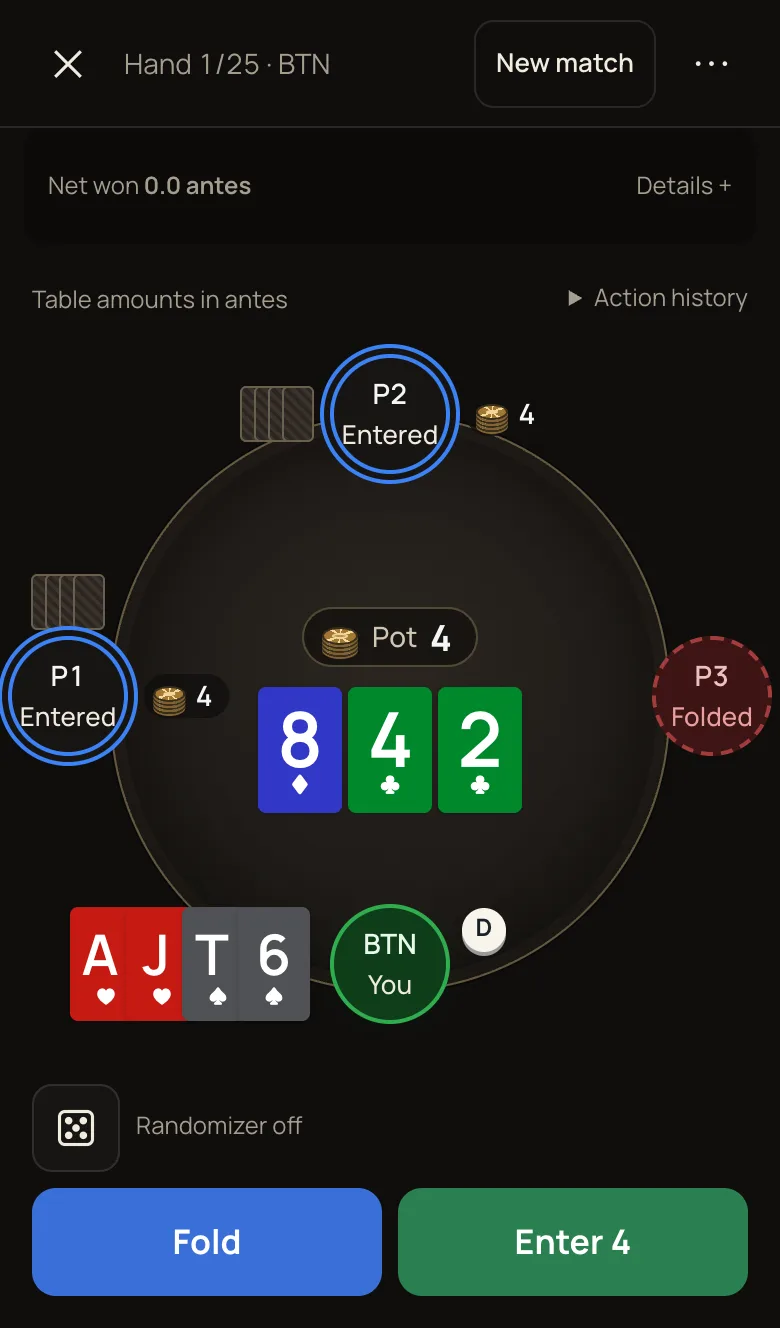
Consecutive hands as the button moves. Play every seat, orbit after orbit.
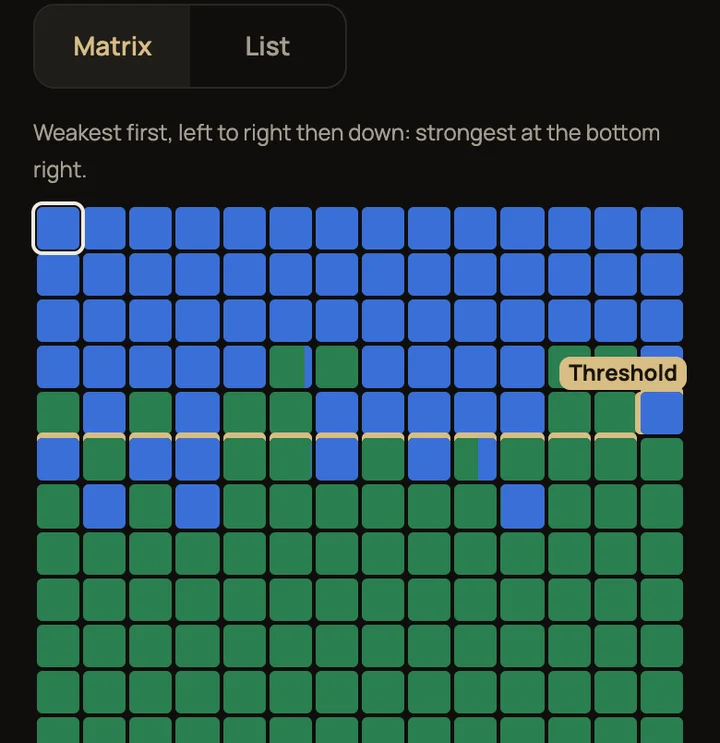
Browse the stored strategy hand by hand, flop by flop, at the available table sizes.
 Illustrative data
Your mistake map ranks leaks by EV lost. Drill the costliest spots first.
Four cards. One choice.
Everyone antes one unit: three players make a pot of three antes. Action runs in seat order, P1 to the button.
Each player enters for a fixed wager equal to the initial ante pot, or folds: 3 antes at a three-player table. If it folds to the button, the button wins the antes without a decision.
A sole entrant wins the antes without paying the entry wager. Otherwise the turn and river are dealt and the best Omaha hand wins: exactly two hole cards and three from the board. With k entrants, you included, entering needs 1/(k+1) of the pot to break even: 1 in 3 heads-up, 1 in 4 three-way.
The stored strategy
210 stored hands for one flop, weakest to strongest. Tap any cell.
Mixed cells show the stored entering probability. This example is from the certified three-player finite-pool policy.
Your mistake map
Recorded EV loss by seat and prior entrants. Tap a cell.
Illustrative three-player example, not your data. Values show total EV loss in antes.
Two to six players
Pick a table size from two to six players. The library's status and verification scope are set out below. Seven-handed: estimated practice (not certified). Paid only.
Six-handed training
Available on Free within the same 20-hands-a-day allowance and one-table-size rule. Six-handed is certified to the same standard as five players: every one of the 1,761 flops checked, with a second reviewer's recheck of every seat bound.
Read how six-handed was certifiedHow the strategy was checked
For two to six players, the checks bound how much any one seat could improve its expected result by changing strategy while the other seats keep playing the reviewed policy. Every one of the 1,761 stored flop records is covered, under the stated 210-hand finite-pool model.
*Per player per dealt hand, using the largest per-record bound across all seats. Percentage = bound divided by the initial pot of N antes, multiplied by 100. Displayed limits are rounded upward. These are bounds on expected gains within the audited model, not winnings forecasts or limits on any single hand’s result.
Free to try: create a free account, 20 trainer hands a day, no credit card. Paid is $49.99 a month.
Free and Paid
Paid removes the daily limit and the one-size rule, opens custom hand analysis at every table size, and adds opponent adjustments.
The core trainer.
or $419/year (save 30%)
No daily limit, every table size, custom analysis at every size.
Questions
A trainer and solver for Cucaroochoo PLO bomb pots. Each player antes, the flop is dealt, and players act in seat order: enter for a fixed wager equal to the initial ante pot, or fold. If everyone before the button folds, the button wins the antes without a decision. The trainer draws on a precomputed strategy library: two-, three- and four-handed spots against the stored strategy are graded from exact values, and a simulation estimate is used only where an exact value is unavailable. The two- to six-handed strategies are certified for the stated finite-pool models (see Methodology). Seven-handed: estimated practice (not certified). Paid only.
You receive a spot from the strategy library and decide. The trainer then grades the decision (Correct, Too close to call, Inaccuracy, Mistake or Blunder), reports its EV and any EV loss, and explains the result in terms of contested pot share, uncontested wins and the stored strategy. Mistakes are recorded to a personal map for targeted review.
By EV loss: the antes given up against the better action. It measures decision cost, not money lost at the table. Inaccuracy is under 0.1 antes, Mistake 0.1 through 1 ante, and Blunder above 1 ante. Two-, three- and four-handed spots against the stored strategy use exact values, marked Exact; when no stored mix applies and entering and folding are less than 0.01 antes apart, the result is Too close to call: either is fine. Other spots use a simulation estimate; when the EV of entering is within 3.5 standard errors of zero, the result is Too close to call. Seven-handed figures are estimates shown with a margin: a grade is called only when the estimate is clear of zero by more than that margin, at 3.5 to 4 standard errors and at least 0.10 antes; otherwise the trainer says Too close. For a mixed hand, either action is correct when their displayed values are within 0.05 antes. Outside that range, choose the higher-value action. If the estimate is too uncertain to distinguish them, the trainer says so.
A record of EV loss by table size, seat and number of prior entrants. Higher recorded loss marks where to review first; selecting a cluster drills those saved spots. A cluster counts as practiced after at least 90% accuracy over your last ten attempts, and becomes due again after a week without practice. The badge records practice, not mastery.
20 trainer hands a day at one table size you choose: 2-, 3-, 4-, 5- or 6-handed. Your first hand of the day picks the size, and the other sizes open again the next day. Heads-up Solve (custom hand analysis, two-handed) uses the same daily hand allowance and does not change your table size. Every hand gets the full verdict, equity and EV, plus the mistake map and your record. No credit card is required.
Paid ($49.99 a month, or $419 a year) removes the daily limit and the one-size rule, opens custom hand analysis at every available table size, and adds adjustments for looser or tighter opponents.
Cucaroochoo trains a specific PLO bomb pot game: four cards each, everyone antes, then enter or fold on the flop. Its fixed entry wager and single decision per player define a different game from conventional pot-limit Omaha. Every decision is explained from the stored strategy and its EV in antes.
Yes. Manage the subscription from the billing portal linked in the app. Paid access continues through the end of the billing period.
Start free
20 free hands a day. No credit card.
Create a free account Go to app